The Walerans and Walronds of Devon and Dorset - the origin of Warland?
Note: Sections of this page draw on the two-volume book of 1,434 pages written or compiled in 1776 by John Hutchins MA, then Rector of the Holy Trinity in Wareham and of Swyre in the County of Dorset, titled 'The History and Antiquities of the County of Dorset: Compiled from the best and most ancient historians, inquisitiones [sic] post mortem, and other valuable records and MSS [manuscripts] in the public offices and libraries and in private hands, with a copy of Domesday Book and the Inquisitio Gheldi for the county, interspersed with some remarkable particulars of natural history and adorned with a correct map of the County and views of antiquities, seat of the nobility and gentry etc'
The word 'warland' appears in the Domesday Book in 1086 as a type of land in so-called Scandinavian parts of England that were subject to the Danelaw; people who lived on that land probably took it as a surname. But that term was not used or recorded in the Domesday Book in the southern and south-west parts of England. So, how or why did the people in that area, who appear (based on DNA evidence) to have been Britons, end up with the same surname?
This page considers whether the surname Warland that appears first in a record in 1490 (see below) might be a variation of the name Waleran or Walrond that was adopted by local Britons (not Normans or Anglo Saxons) who were living on land that was given to the Waleran or Walrond family after the Norman conquest. For reasons indicated below, some of these Britons may have been working on land owned by monasteries.
The Norman Waleran Venetor
According to Hutchins (volume 2, page 306) Waleran Venetor '... seems to have been a Norman who came over with William the Conqueror, who gave him the manors of Manston, Great Kington (Kington Magna), Sutton-Walrond, Winterborn, Dodesbery, Fifehide, Knoll, Maiden-Newton and Toller, all of which he was possessed of when Domesday Book was made'. Most of these locations are to the west and north-west of locations in Dorset where the Warlands were recorded living.
At some unknown time, the name Waleran appears to have become Walrond.
The chapter 'A Dissertation' in volume 1 of Hutchins history of Dorset contains the following text relating to Waleran Venetor:
WALERAN VENATOR. We are not to wonder that a prince who had so strong a passion for the chace [sic] as the Conqueror made good provision for his huntsman. The author of the Saxon Chronicle speaking of the very rigorous laws he enacted for the preservation of the game, says 'he loved the deer as if he had been their father': Accordingly, we find Waleran possest of eight manors. That of Sutton took the name of Walrond from him, or from its succeeding lords the Walronds, antient [sic] barons, probably his descendants'.
The page Walrond History, Family Crest and Coats of Arms on the House of Names website states that 'The surname Walrond was first found in Devon where the name is believed to be descended from Waleran, the great Baron of Essex, Count of Meulan in Normandy'. The page also notes that known variations of the Walrond name include Walerend, Walerond, Waleran and others'.
We are not suggesting that the Warlands of Dorset were the descendants of or are somehow related to the Waleran/Walrond families; DNA evidence suggests they were Britons. Instead, the theory here is that these Britons may have got their version of the surname from the land held by those families in a similar way to how the (unrelated) peasants living on 'warland' in the Danelaw areas adopted that word for their surname.
Page 306 of volume 2 of Hutchins history discusses Walter, one of Waleran's descendants, with details of travel to Normandy, the giving of 'E. Dene c. Wilts' to the community of the church of Sarum (just north of present-day Salisbury, known as 'Old Sarum'), and Walter's marriage to Isabel, the daughter of William Longspee earl of Salisbury (one time holder of Canford Magna - see below). It then goes on to discuss the life of Robert Waleran and the fact that he died without issue; his heir became his nephew (also named) Robert Waleran, the son of Robert's brother William.
The above suggests the possibility that the Britons who later became Warland were living on the lands held by the Waleran/Walrond family, including church land, and may have ended up moving or being re-located to other lands held by the same family closer to where we find the first Warlands in Dorset in the early 1600s - if not before.
Waleran of Devon
Prior to 1066, Fifehead Neville was held by an unnamed English thegn (nobleman), but by the time of the completion of the Domesday Book in 1087, the manor of Fifehead Neville is recorded as being in the possession of Waleran Venator. The name Waleran (meaning Wall or 'Strong' Raven the Huntsman) is Germainic, and was introduced to Britain by the Anglo-Saxons in the eighth century, but was also re-introduced at the Conquest by the Norman-French. Waleran could possibly have been a native Englishman, but it is more likely that he was a Norman invader, who accompanied William I on his Conquest, and as a favourite was rewarded with huge hunting estates. His under-tenant in Fifehead Neville was Ingelrann, who also held land in Somerset after the Conquest (see Domesday Fifehead). (Source: http://www.thefifeheadtree.btck.co.uk/Roots-WhatsinaName/WalerananddeNevilleFamilies)
The Domesday survey of 1086 noted the following:
LAND OF WALERAN THE HUNTSMAN. Waleran holds COTEFORD of the King. Erlebald held it in the time of King Edward, and it paid geld for 6 hides. The land is 6 carucates. Of this there are in demesne 3 hides, and there are 2 carucates, and 3 serfs; and there are 7 villans.
The following information is taken from the book, 'The Ancestry and Descendants of John Alexander Thompson Nexsen' by Joshua Nexsen, published in 1925.
[The name Waldron is an] old Devonshire family, called at different times de Waleran, Walleronde, Walrond, Walrund, and Waldron, were seated at Bradfelle in the time of Henry II. The original deed of transfer of Bradfelle from Fulke Payne, Lord of Brampton, to Walerande at the time of King John is still in possession of the family. The deed is not dated, but Fulke Payne was dead previous to the first year of the reign of Henry III. The Walerans were of Baronial rank at the time of King Henry II.
Sir Walter II Waleran (abt 1160, Broad Chalk, Wiltshire - abt 1200), 'Venator' (the hunter), Lord of Grimstead. Son of Sir Walter Waleran (1120 - 1155). Married Isabel Longspee (1150/54 - ), supposedly descended from William Longspee, Earl of Salisbury. Walter and Isabel had three daughters. Walter Waleran died in around 1200.
- Albreida/Albreda (1170/80 - ) who married John de Monmouth
- Cecelia / Cecily / Margaret (1183/84 - )
- Isabel / Maud (1185/88 - )
The Cogdean Hundred area of Dorset after the Norman Conquest
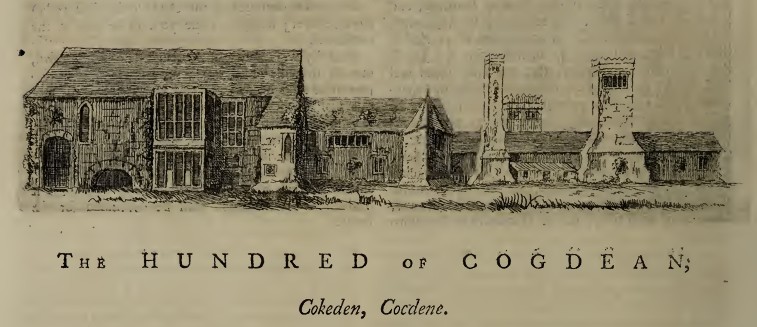
The drawing at the top of the chapter on the Cogdean Hundred
Volume 2 of Hutchin's history contains a chapter on the Hundred of Cogdean (aka Cokeden, Cocdene), an area that included the tithings of Canford Magna, Long Fleet, Kinstanton, Parston, Charlton Marshal in Spettisbury, Lichet Matravers, Sturminster Marshal, Hamworthy, Corf Mullen, Comb Almer and Lichet Minster. Many of these places were the location of Warland families from the early 1600s (and likely earlier).
According to Hutchins, 'very early' after the Norman Conquest, the Cogdean hundred 'which was always an appendage to the manor of Canford and belonged to the lords of it' was held by Peter Lucyan. It was then held as follows:
- The Longspees, earls of Sarum - note the link with the Walter Waleran/Walrond above.
- Dukes of Lancaster and earls of Lincoln
- 20 R II (1397) - Thomas Holland, earl of Kent
- 14 H VI (1436) - John, duke of Bedford
- I E VI (1547/8) - Edward, duke of Somerset 'and other grantees of the manor'
- 10 Jac I (1613) - John Webb, then Sir John Webb
Canford Magna and Kington Magna
Hutchins (volume 2, page 100) states that the parish of Canford Magna ' is a large one and lies about two miles SE from Wimborne Minster on the south side of the river Stour in the east part of the hundred. It belonged to the duchy of Lancaster.' The area was known as Cheneford in the Domesday Book which noted it was held by Edward of Sarisberie.
Hutchins (volume 2, page 306) states that Kington Magna 'probably takes its name from having been part of the ancient demesne of our kings before the conquest, lies in the north part of this county, one mile and half to the north west from Fifehide Magdalen. … In the Domesday Book it seems to have been surveyed in two parcels. Ernulfus de Hesding held Chintone (with five carucates) of the king (while) Ranulfus held Chintone (with two carucates), of Waleranus'. He notes that two authors suggest that the name Kington derives from the ancient name Cinton.
Note: A 'carucate' was a medieval unit of land area, roughly the amount a team of eight oxen could plough in a year, typically around 120 acres.
As a side but possibly related note, the plague known as the 'Black Death' arrived in Dorset in 1348 and spread quickly along the coast and up the river valleys. According to the Dorset History Centre's page The arrival of the black death in Dorset dated 6 April 2020, the progress of the plague 'may be plotted by the appointments of extraordinary numbers of parish priests to replace those who died. During the month of November, the bishop of Salisbury appointed new priests on twenty-two different days'.
Is it possible that the death of so many people and churchmen from the plague in the Hundred of Cogdean meant that others were brought in from other places to replace them? Perhaps a Briton (who by this time had lost the memory of his ancestors) from a monastery on one of the (perhaps former) Walrond lands?
In 1490, a John Worland [sic], clerk, was noted as the vicar of the church of Canford and Kinson from 28 April 1490, remaining in that position until, on the resignation of John Warland, he was replaced by John Hassard (also a clerk) on 7 April 1511. (Source: Hutchins, Vol 2, page 112, in the chapter 'The Hundred of Cogdean (Cokeden, Cocdene)'. See also the page on the Warlands in Wimborne Minster for additional information on this man and his connection with that location.
Nothing is known about this John Worland/Warland before 1490 but the fact that he was a church clerk suggests a level of education that he may have gained by living (with the rest of his family) on lands held by the church.
For more information about Cheneford/Canford Magna and Warlands located there from the early 1600s, see The Warlands of Canford Magna.
Sutton-Walrond
According Hutchin's chapter on the Hundred of Redlane (volume 2, page 326), Sutton-Walrond was a little parish that 'took its principal name South-tone, quasi South-Town, from its situation with respect to some adjacent place, and its additional one from its ancient lands, the Walronds. It lies two miles north from Shroton'. This is about half way between Shaftsbury and Blandford; the latter is linked with the first Warland in Australia, William Henry Warland, who was born there and who went to Australia in 1823. In a letter dated 15 February 1827, Warland wrote that he was '... a single man ... bred to Agriculture from my youth, my family having occupied a farm belonging to Sir John Webb in Dorsetshire for upwards of 200 years.'
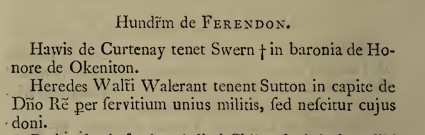
Details of Walter Waleran's holding in Sutton in the Hundred of Ferendon.
Hutchins states that 'In the Domesday Book [Title 47], Waleranus venator held Sudtone (consisting of) six carucates ... From the Walerans or Walronds, of whom an account has been given in Great Kington, this manor does not seem to have passed to the Plugenets* but to other branches of that family of which the following records give a curious account'. The text that follows describes what allegedly happened after the barony of Walrond in Wiltshire and Dorset was divided into three parts by the co-heiress of William Walrond and afterward underwent another division or distribution 'in the course of heritage'. It mentions (a) 'the third part of the barony of William Walrond, which Joan de Nevile, grandmother of the said Reginald [son and heir of William de St Martin] had for her purparty' and (b) Walter de Walrond holding land 'for the king in chief'.
*A Norman family
Maiden-Newton
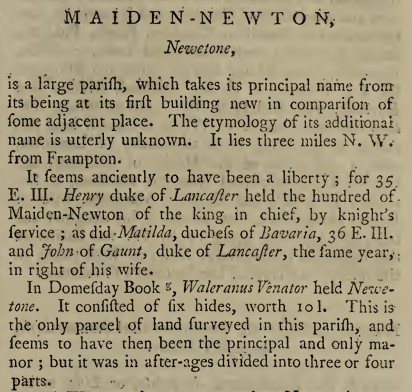
Details of Waleran's holding in Maiden-Newton. (Hutchins, Volume 1, page 517)
The (large) parish of Maiden-Newton is described from page 517 in the chapter on the Hundred of Tollerford in volume 1 of Hutchin's history of Dorset. Hutchins notes that this location 'takes its principal name from its being at its first building new in comparison of some adjacent place (while) the etymology of its additional name is utterly unknown. It lies three miles north west from Frampton.
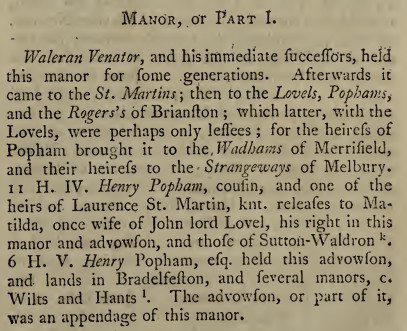
Details of the disposal of the land held at Maiden-Newton. (Hutchins, Volume 1, page 517)
Hutchins note that 'Waleran Venator and his immediate successors held (the) manor for some generations after which it passed to the St Martins and so on'. The Domesday Book states that Waleran Venator held Newetone, consisting of five hides. Hutchins notes that 'This is the only parcel of land surveyed in this parish and seems to have been the principal and only manor, but it was in after-ages divided into three or four parts'.
Conclusions to be drawn from the above
What we can draw from the above information is that the surname Warland adopted by local Britons in the Dorset area after the Norman Conquest in 1066 would have been based on a variation of Waleran or Walrond. This theory is no stronger than the other theory that the Britons in the Dorset area got their surname because they lived on what was described in the Domesday Book in 1086 (in the Oxford area) as 'warland'. The problem with the Oxford/Warland theory is that the word 'warland' wasn't commonly used in the former Wessex area. It seems just as likely that the Britons took on a variation of the name Walrond which was, by contrast, more common in the area from Devon to Dorset.
Page created 18 July 2026, updated 21 January 2026. Copyright © Andrew Warland. (andrewwarland(at)gmail.com)